
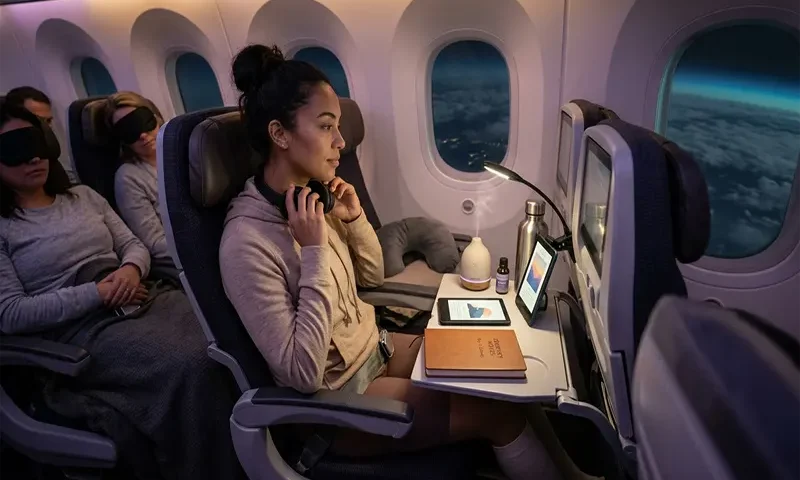
For many solo travelers, the prospect of a 15-hour flight is not an adventure—it’s an endurance test. If you experience flight-related anxiety, the cabin can feel like an isolating, high-stakes environment where every bump in the air feels magnified. However, the secret to surviving these long hauls isn’t about “getting through” the time; it’s about reclaiming your agency. By viewing the flight as a curated space for self-care rather than a period of forced confinement, you can lower your nervous system’s baseline stress and arrive at your destination feeling empowered.
The ‘Pre-Flight Foundation’
Anxiety management doesn’t begin at 30,000 feet; it starts with the environment you create before you board.
- The Comfort Ritual: Build a “calm-down kit.” This should include sensory anchors: a vial of lavender or eucalyptus essential oil (scent is a direct bypass to the brain’s emotional center), a favorite tactile fidget tool, and familiar, “safe” snacks.
- Strategic Logistics: Arriving early at the airport eliminates the adrenaline spike of rushing. When choosing your seat, consider the “wing” seats; physics dictates that this is the point of least oscillation, providing a smoother ride during turbulence.
- The Golden Rule: Avoid caffeine and alcohol entirely. Caffeine mimics the physiological symptoms of anxiety (elevated heart rate, jitteriness), while alcohol dehydrates you and can lead to restless, anxiety-prone sleep.
In-Flight Sensory Grounding
When your thoughts begin to spiral, your body needs an immediate anchor to the present.
The 5-4-3-2-1 Technique
When you feel the “fight-or-flight” response kick in, ground yourself using your five senses:
- 5 things you can see: (e.g., the tray table latch, a fellow passenger’s shoes, the clouds).
- 4 things you can touch: (e.g., the fabric of your seat, the coolness of your screen, your own hands).
- 3 things you can hear: (e.g., the hum of the engine, a distant conversation, your own breath).
- 2 things you can smell: (e.g., your essential oil, the air-conditioning).
- 1 thing you can taste: (e.g., a sip of water or a lingering mint).
The ‘Muscle Pump’ & Breathing
Anxiety often causes us to freeze, which traps tension in our bodies. Practice “Box Breathing”: Inhale for a count of 4, hold for 4, exhale for 4, and hold for 4. This rhythm forces your heart rate to normalize. Pair this with simple seated stretches—ankle circles and calf pumps—to keep blood flowing and prevent the physical feeling of being “trapped.”
Mental Distraction vs. Avoidance
The goal is to keep your brain occupied without over-stimulating it.
- Low-Stakes Content: Avoid thrillers or news, which spike cortisol. Curate a “feel-good” playlist of comedies, nature documentaries, or light-hearted travel content.
- Cognitive Shuffling: If your brain is looping on worries, play a game of “Cognitive Shuffling.” Pick a neutral word like “CAMP.” For “C,” think of cat, car, cake; for “A,” think of apple, ant, acorn. This scrambles the logical, linear thought patterns that fuel anxiety and occupies the brain with neutral, “low-emotional” work.
Seeking Support
There is no need to suffer in silence. Upon boarding, briefly mention to a flight attendant: “I’m a bit of a nervous flyer, so I might just check in if I’m feeling overwhelmed.” Flight crews are extensively trained in managing passenger comfort and will often make a point to check on you, providing that extra layer of external reassurance that can make all the difference.
Reframing the Narrative
Embrace “Radical Acceptance.” Acknowledge that the fear is present, but remind yourself: The fear is a feeling, not a fact. You are safe, the aircraft is a marvel of engineering, and the anxiety is just a temporary passenger. Do not fight the feeling; observe it, breathe through it, and let it pass.
A 15-hour flight is simply a quiet, uninterrupted window of time. By curating your space, engaging your senses, and practicing these grounding tools, you transform the cabin from a source of stress into a sanctuary of stillness. Focus on the “why” of your travel—the destination that awaits you—and trust that the flight is merely a temporary passage. You have the tools, the agency, and the resilience to arrive on the other side.

