
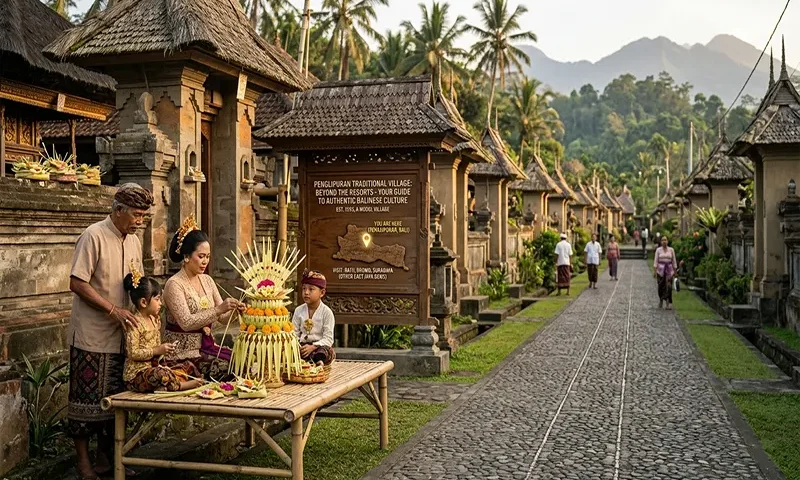
For decades, the southern coastline of Bali—the bustling strips of Seminyak and the chic cafes of Canggu—has defined the island’s image for the international traveler. Yet, there is another Bali, one that breathes with the rhythm of ancient traditions, communal harmony, and deep-rooted spirituality. This is the Bali of the highlands, where life remains tethered to the Banjar (village council) and the cosmic balance of the island’s heritage.
If you are looking to peel back the layers of Bali’s “tourist bubble,” your journey begins in the traditional villages. Here, authenticity isn’t a performance; it is a way of life that has survived for centuries.
The Architecture of Community: The Penglipuran Model
Penglipuran is perhaps the most famous of Bali’s traditional villages, and for good reason. As you walk through its main path, the first thing you notice is the striking symmetry. Unlike the chaotic sprawl of the southern towns, Penglipuran is laid out in a precise, linear fashion.
The village is anchored by its Angkul-Angkul—traditional bamboo-roofed entrance gates that mark the threshold between the public world and the private home. Everything here is intentional. The village is organized according to the philosophy of Tri Hita Karana: the harmony between humans, nature, and the Divine. In 2026, as the world moves at a frantic pace, Penglipuran stands as a living testament to the power of community governance. It is not a museum; it is a functioning, thriving village where families have lived for generations.
The Art of Respectful Observation: A Visitor’s Code of Conduct
Entering a traditional village is a privilege, not a right. To ensure your presence supports rather than diminishes the community, follow these core tenets:
- Temple Etiquette: Never enter a temple without a sarong and a sash. Beyond the dress code, remember that a temple is a sacred site. Do not walk in front of people who are praying, and never stand higher than the priest or the offerings.
- The Banjar System: Recognize that village life is governed by the Banjar. If you see community meetings, communal work, or ceremonies in progress, observe from a distance. You are a guest in their living room.
- The Ethics of the Lens: Before snapping a photo of a person or a private ceremony, always ask. Smile, gesture toward your camera, and wait for a nod. Prioritize human interaction; you will often find that a brief, genuine conversation leads to a richer experience than any photograph ever could.
Beyond Penglipuran: Living Communities
While Penglipuran is a perfect introduction, the highlands are filled with villages that offer unique windows into tradition:
- Tenganan: Located in East Bali, this is one of the oldest villages on the island. It is home to the Bali Aga people, who have maintained pre-Majapahit customs. It is famous for Gringsing—a rare, double-ikat textile that takes years to create.
- Trunyan: Situated on the edge of Lake Batur, Trunyan is famous for its unique burial customs, where bodies are placed under a special taru menyan tree that purportedly neutralizes the scent of decay. It is a place that demands the utmost respect and solemnity.
Participatory Experiences: Giving Back
The most authentic way to experience Bali is to shift from spectator to participant. Instead of a one-hour stopover, consider:
- Homestays: Stay with a local family. It provides direct economic support to the household and offers an unvarnished look at daily life, from the morning prayer rituals to the preparation of meals.
- Craft Workshops: Seek out local masters who teach bamboo weaving or the intricate art of making Canang sari (the daily floral offerings). These are not just crafts; they are expressions of Balinese devotion.
- Cooking Classes: Learn to prepare Lawar or Bebek Betutu in a traditional kitchen. You will learn more about Balinese culture through its spices and communal preparation than you ever would in a restaurant.
The Slow Travel Ethos: Waking with the Village
Authentic culture rarely reveals itself to the “drive-through” tourist. To truly experience the heart of these villages, you must commit to the pace of the place. Stay for two or three days.
Wake up as the village wakes up. Watch the grandmother in the next house place her Canang sari at the family shrine, followed by a prayer of gratitude. Listen to the faint, melodic sounds of a gamelan practice echoing through the valley at sunset. This is the “real” Bali—the one that exists in the spaces between the tours.
A Fragile Resource
Authentic culture is a fragile resource, susceptible to the pressures of mass tourism. As a traveler in 2026, your role is that of a custodian. When you visit these villages, aim to leave the community exactly as you found it—physically, culturally, and spiritually. By approaching these traditional spaces with humility, curiosity, and respect, you don’t just see Bali; you participate in its preservation.

