
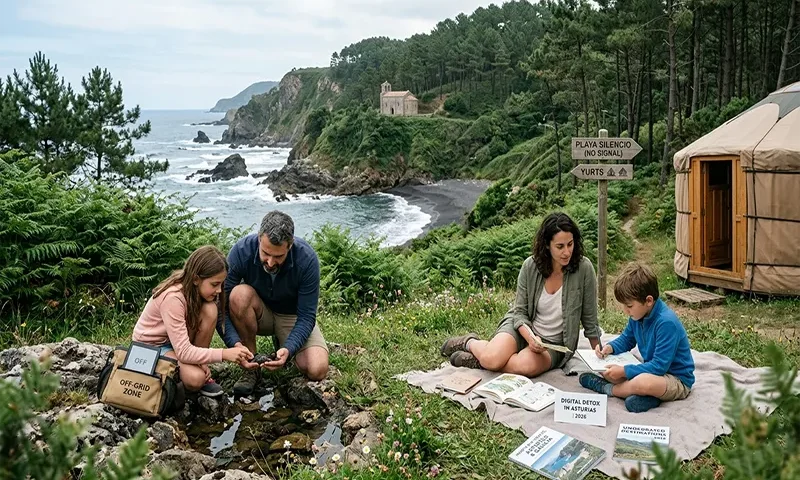
In 2026, being “always on” is no longer a professional virtue; it is a cognitive tax. We live in an era of hyper-connectivity, where the boundary between our professional responsibilities and personal space has eroded under the weight of constant notifications. A digital detox, therefore, is not a deprivation—it is the ultimate modern luxury. It is a deliberate reclamation of your own attention.
True disconnection requires more than just willpower; it requires an “organic barrier”—a geography so remote or a rhythm so slow that the digital world naturally falls away.
The Philosophy of Unplugging
The nervous system requires time to recalibrate. Research suggests that the “72-hour mark” is the gold standard; it takes roughly three days of sustained disconnection for cortisol levels to normalize and for the brain to move from a state of “scanning for threats” (scrolling) to “present-moment awareness.”
5 Destinations to Reclaim Your Focus
1. Bhutan: The Sacred Valleys
Bhutan’s commitment to “Gross National Happiness” extends to its landscape. With its high-altitude peaks and protected monasteries, the terrain itself is a natural signal-blocker.
- Reconnect Activity: Embark on a guided hike to a cliffside monastery. The rhythmic sound of prayer wheels and the absence of cellular infrastructure create a space where your focus naturally shifts from the screen to the horizon.
2. Southwest Wilderness, Tasmania, Australia
This is the edge of the world. Southwest Tasmania is a vast, untamed expanse of ancient forests and rugged peaks, largely inaccessible by road.
- Reconnect Activity: Multi-day wilderness trekking. When you are traversing landscapes that haven’t changed in millennia, the concept of a “pushed notification” loses all relevance.
3. Alejandro Selkirk Island, Chile
For those who want to be completely off the map, this remote Pacific island—reachable only by supply ship—offers absolute isolation.
- Reconnect Activity: Deep observation. Without the distraction of infrastructure, you are forced to engage with the raw environment. It is the purest form of disconnection currently available on the planet.
4. Alentejo, Portugal
A “slow-travel” sanctuary where the rhythm is dictated by the sun and the harvest.
- Reconnect Activity: Vineyard walking and coastal exploration. The Alentejo coast is remarkably untouched, with wide, empty beaches that invite long, analog walks. It is the perfect place to relearn how to exist without a destination.
5. Shikoku, Japan
Home to the 88-Temple Pilgrimage, Shikoku is a testament to the power of the journey. The island’s zero-waste ethos and focus on mindfulness provide a perfect backdrop for a digital reset.
- Reconnect Activity: Walking a portion of the pilgrimage trail. The act of repetitive, rhythmic walking is a proven method for silencing the internal chatter of a distracted mind.
The ‘Detox Toolkit’
You don’t have to go into your detox blindly. Use these tools to ensure your transition is successful:
- The Emergency Protocol: Before leaving, designate one “trusted contact” who has your physical location and the hotel/lodge phone number. Share this with your workplace or family. Knowing a safety net exists allows your brain to let go of the “what-if” anxiety.
- The Analog Replacement: Do not leave a vacuum. Replace the time you usually spend scrolling with a physical book, a film camera, or a dedicated journal. These tools engage the tactile brain, which is far more satisfying than the abstract light of a screen.
- The 72-Hour Standard: Commit to a minimum of three days. The first 24 hours will feel like “phantom vibration syndrome,” where your brain demands stimulation. By the third day, the urge usually subsides, replaced by a profound sense of cognitive quiet.
Returning with Boundaries
A digital detox is not about running away from your life; it is about returning to it with higher standards. By spending time in environments that necessitate focus and silence, you rewire your brain to value deep work and meaningful presence over fragmented attention. When you finally return to the digital world, you will do so with firmer boundaries, a clearer mind, and the distinct knowledge that you are the master of your own focus.

